
Willacy Projected Versus Actual Release
TDCJ defines Projected Release Date as the date Classification and Records projects release from incarceration if parole does not occur sooner. The label may reflect different statutory endpoints based on offense date and mandatory-supervision eligibility. It is neither a promise nor proof that the person departed. A Scheduled Release Date appears after TDCJ receives a release certificate and audits the record. Processing is further along, but TDCJ warns that the date can change even on release day.
Actual Release Date records the custody event. Release to parole or mandatory supervision ends prison confinement while community custody continues. Final discharge usually marks the end of the sentence obligation. A pretrial detainee has no sentence-based projected date. Bond, dismissal, another hold, or a later judgment may control instead.
Find Willacy Projected Release Dates
First identify whether the person entered TDCJ. A Willacy arrest alone does not create a state-prison record. A judgment, commitment, WCSO hold notation, or TDCJ number supplies the bridge.
- Read the court record for the sentence, cause number, county of conviction, and commitment authority.
- Search the TDCJ Online Inmate Search with exact identifiers.
- Match the name, TDCJ number, SID, birth date, offense, and conviction county.
- Record the unit and each date label exactly.
- If the locator fails, email pia@tdcj.texas.gov with the required identifiers.
- After the expected date, verify actual release or continued custody.
The free TDCJ email lookup may return location, offenses, court data, history, and Projected Release Date. It does not provide photos. For county custody, use the court and WCSO route in the Willacy County release search.
Willacy TDCJ Good-Time Rules
Texas Government Code Chapter 498 governs good-conduct time. Classification, participation, forfeiture, suspension, and possible restoration matter. Credits are not a fixed discount, and suspended credit cannot count while suspended.
Section 508.147 supplies the mandatory-supervision equation for eligible cases: calendar time plus accrued good time equals the sentence, subject to exclusions and Board review. Later eligible cases require Board approval. A denial can move projection to maximum expiration, while later approval can move it earlier.
Texas has no universal 85 percent rule. Section 508.145 contains offense-and-date-specific paths. Some serious cases use one-half the sentence or 30 calendar years, whichever is less, without good time. Others may use calendar plus good time under a one-fourth or 15-year framework. Special offenses and life terms add rules. Eligibility is an opportunity for review, not release.
Why Willacy Release Dates Move
TDCJ owns the calculation because it holds the judgment, sentence structure, jail credit, classification history, forfeitures, and Board action. Each can alter the result.
| Factor | Possible effect |
|---|---|
| Good-time classification | Changes eligible credit. |
| Forfeiture or suspension | Removes credit from the active calculation. |
| Board decision | Denial or later approval can move projection. |
| Parole action | May create an earlier path, but approval is not departure. |
| Sentence or jail-credit correction | Changes the base computation. |
| Audit or record change | Can alter projected or scheduled dates. |
| Another agency hold | May cause transfer instead of community release. |
Do not use homemade arithmetic. Without the offense-date law, consecutive terms, findings, full credit history, and Board record, a private calculation would be unsupported.
Confirm Willacy Actual Release
Texas has no formal public individual parole hearing calendar. Board members review and vote files. A favorable FI code may depend on a program or future date, while NR, SA, RMS, and DMS represent different outcomes. Use current Board guidance and the Parole Status Line at 844-512-0461.
After a favorable result, Review & Release Processing at 512-406-5202 addresses post-vote processing. A result can be reconsidered, and certificate audit can change timing. After release, Harlingen DPO serves Willacy parole and mandatory supervision, but that office assignment alone does not prove where a named person reports.
Notification remains supplemental. The Willacy County VINELink inmate search explains the IVSS transition and the separate TDCJ notice layer.
No Willacy 85 Percent Rule
Willacy's key computation caution is the absence of a universal Texas 85 percent rule. Federal shorthand cannot be imported into a Texas sentence. The statute varies by offense, date, findings, eligibility, and sentence structure. Good time may be suspended or forfeited, while discretionary mandatory supervision may be denied and later approved.
No published Willacy County Jail good-time table, early-release practice, or weekend adjustment was found. State-prison rules cannot be copied onto a county sentence. For a county term, the judgment, credit, and WCSO record control.
Note: A projected date is a TDCJ label, not a promise that all custody or supervision ends that day.
Willacy TDCJ Date Definitions
The official TDCJ definitions page supplies the controlling meanings for projected release labels.
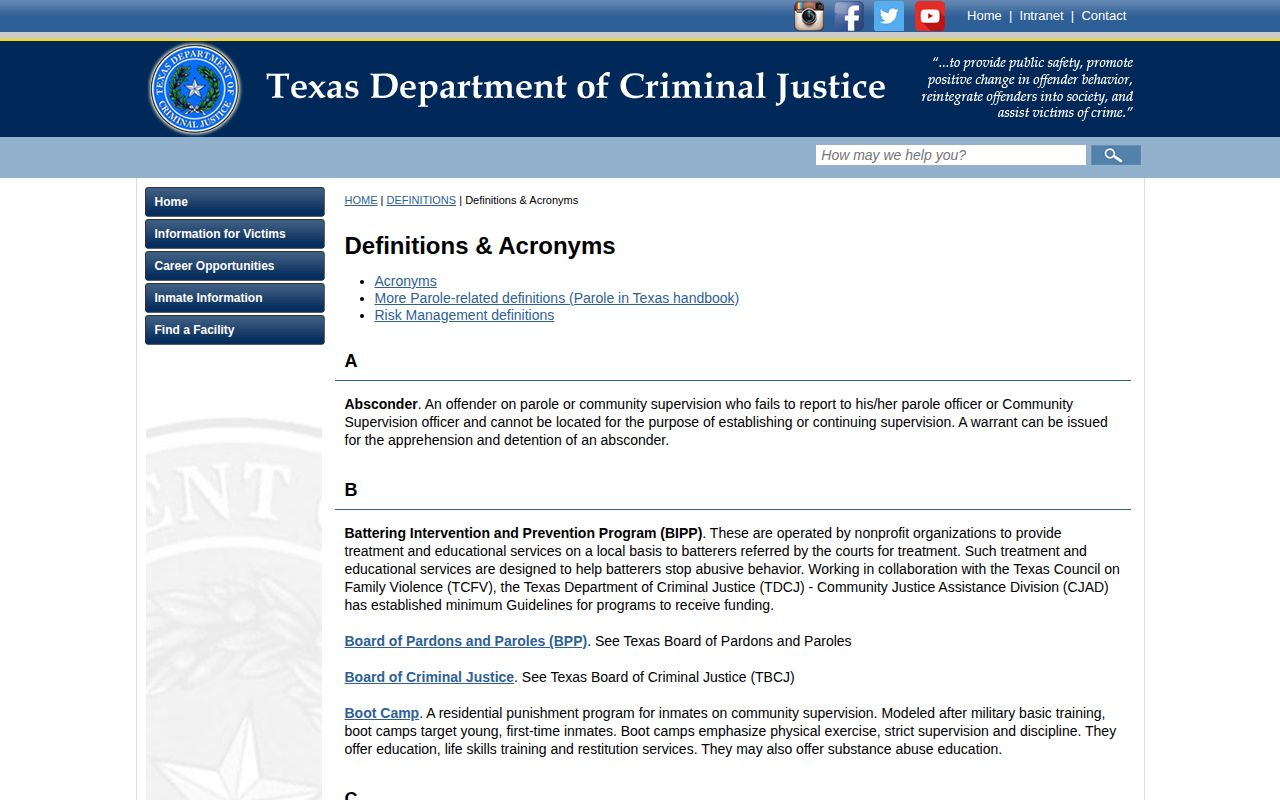
The state capture shows why official labels and the current TDCJ calculation should replace private sentence math.
Willacy County Release Date Records
A sentenced person held only by Willacy County does not use the TDCJ framework unless the judgment commits that person to state custody. Ask WCSO for booking history and the release-or-transfer notation. Ask the clerk for the judgment, sentence, commitment, dismissal, bond order, or later order.
A bond order authorizes release but does not prove processing finished. A commitment points to transfer. A dismissal may end one charge while another hold remains. The cause number connects jail and court records and limits mistaken matches.
WCSO is at 1371 Industrial Drive, Raymondville, TX 78580, and its jail line is 956-689-5576. No fixed release hour, duration, exit site, county formula, or weekend rule was found. Ask whether processing is complete, then seek the written entry.
Read Willacy Release Date Evidence
A useful date record identifies the authority and event, not just a number. For TDCJ, preserve the TDCJ number, unit, offense, conviction county, cause number, review information, and exact date labels. A unit change is a transfer within state custody. If the locator no longer returns the person, use TDCJ's direct information channel before concluding that release or discharge occurred.
Once TDCJ receives a release certificate, Classification and Records audits the calculation and sets a scheduled date and location. Research found a general audit description of about 14 to 21 business days for that scenario, but it is not a personal deadline. Program-conditioned release can take longer. Even a scheduled date may change on the date shown.
After the expected event, seek actual release status. If the sentence expired, ask for discharge data. If release was to parole or mandatory supervision, report that community custody continues. If another agency accepted the person, call it a transfer. These distinctions prevent a projected date from being mistaken for the end of every legal obligation.
Willacy Date Record Details
For a failed locator search, use TDCJ's email service. Send the full name and seven-digit TDCJ number. If unknown, include the exact birth date or approximate age and county of conviction. The response may supply location, offenses, court, history, and projected date. A formal request is better for historic release or discharge proof.
Offense date matters because Texas law changed. A statutory exclusion, deadly-weapon finding, consecutive term, corrected jail credit, or Board action may change the analysis. Two people with sentences of the same stated length can therefore have different projected dates.
Read court entries by function. A sentence states punishment and credit but may not show physical exit. A commitment points to transfer. A revocation can explain renewed custody after an earlier release. Pair the order with the WCSO booking-out or transfer entry.
Name the Willacy Release Boundary
Every final statement should name the custody boundary that ended. “Released from WCSO” means county custody ended, unless the same record shows transfer. “Released from TDCJ incarceration to parole” means prison confinement ended while state supervision continued. “Discharged” is a later and broader event. The difference matters when a family member is arranging contact, following a court case, or checking whether the person still has an official reporting duty.
Willacy's cluster of facilities makes the agency label especially important. The county jail, active Willacy Unit, regional detention facility, and closed former federal contract center are not one system. A person physically moved from a Raymondville building may remain in custody under TDCJ, Hidalgo County, USMS, or ICE. Building departure alone cannot supply an actual community release date.
Preserve a short evidence trail: the search date, exact status wording, identifiers used, agency name, and source document. Then confirm any change through the record creator. This avoids turning an old screen capture or stale roster entry into a current claim. It also makes later corrections easier when TDCJ audits a sentence, the Board changes a decision, or the court enters a new order.